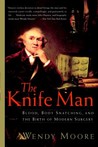
 The Knife Man: Blood, Body Snatching, and the Birth of Modern Surgery by Wendy Moore
My rating: 4 of 5 stars
Amazon Book Description
In an era when bloodletting was considered a cure for everything from colds to smallpox, surgeon John Hunter was a medical innovator, an eccentric, and the person to whom anyone who has ever had surgery probably owes his or her life. In this sensational and macabre story, we meet the surgeon who counted not only luminaries Benjamin Franklin, Lord Byron, Adam Smith, and Thomas Gainsborough among his patients but also “resurrection men” among his close acquaintances. A captivating portrait of his ruthless devotion to uncovering the secrets of the human body, and the extraordinary lengths to which he went to do so—including body snatching, performing pioneering medical experiments, and infecting himself with venereal disease—this rich historical narrative at last acknowledges this fascinating man and the debt we owe him today.
An excellent combination of a compelling narrative of a most influential scientist with the evolution of the practice of surgery and medical science. Ms. Moore has artfully told the store of John Hunter and his rise from the son of a Scottish farmer to a pioneer in medical and anthropological studies. While there are many extremely graphic scenes conveyed to the reader, they are necessary to gain the appreciation of how barbaric some of the acceptable practices in medicine were at the time. This is not a book for the faint-of-heart but is a book for anyone interested in how John Hunter influenced so many of the future generations of medical experts that have been a part of understanding and providing breakthroughs in healthcare over the last 200 years. The field of forensic science, dentistry, anthropology, geology and zoology, to name a few, all have a link back to the years of research conducted by John Hunter. The last two lines of the book sums it up nicely by William Clift who said, "From the beginning, I fancied, without being able to account for it, that nobody about Mr. Hunter seemed capable of appreciating him. He seemed to me to have lived before his time and to have died before he was sufficiently understood."


No comments:
Post a Comment