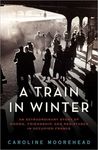
 A Train in Winter: An Extraordinary Story of Women, Friendship, and Resistance in Occupied France by Caroline Moorehead
My rating: 4 of 5 stars
Amazon Book Description
In January 1943, 230 women of the French Resistance were sent to the death camps by the Nazis who had invaded and occupied their country. This is their story, told in full for the first time—a searing and unforgettable chronicle of terror, courage, defiance, survival, and the power of friendship. Caroline Moorehead, a distinguished biographer, human rights journalist, and the author of "Dancing to the Precipice" and "Human Cargo", brings to life an extraordinary story that readers of Mitchell Zuckoff’s "Lost in Shangri-La", Erik Larson’s "In the Garden of Beasts" and Laura Hillenbrand’s "Unbroken" will find an essential addition to our retelling of the history of World War II—a riveting, rediscovered story of courageous women who sacrificed everything to combat the march of evil across the world.
A very fascinating and well written account of 230 women from France that stood up and took part in the Resistance. The book follows them on the journey of German occupation of France to their fate up to and after the liberation of the concentration camps. The author did what great authors do and that is impose thought and reflection on what you've read. There were a lot of questions that were raised for me that will give cause to research and learn more about the many topics discussed. I think about how many Holocaust memoirs and accounts I've read and I realize that even if it's now at 30 to 40, in relation to the 6 million Jewish lives and millions of others lost during the commission of these atrocities, I've read about less than 1% of the stories of those who perished or were victims who survived only to wish they hadn't.
"It was not long after Charlotte Delbo came home to Paris that she began to write about the German camps. Much of it was in verse. 'I've come back from another world,' she wrote,
to this world
I had not left
and I know not
which one is real...
As far as I'm concerned
I'm still there
dying there
a little more each day
dying over again
the death of those who died...
I have returned
from a world beyond knowledge
and now must learn
for otherwise I clearly see
I can no longer live"- page 476
Here are thoughts I shared throughout the book as commented on in a buddy read thread in the WWII reading group. I have hidden due to spoilers so click the link to read more.
(view spoiler)[There is a large volume of women and men of the Resistance introduced in the first 4 chapters. At first I was quite overwhelmed with trying to keep them all straight and remember their individual story lines. What I found rewarding was that I went back and reread the preface and had gained and retained more about those men and women Moorehead introduced than I thought I had. That's a testament to her writing style and the dedication she has shown in telling their story in a way that has brought them to life.
The first four chapters do provide an excellent look into the mood and temperament of the Germans and how that changed from that of almost blending in during June of 1940 to more and more oppressive as time went by and the Resistance became more active and more combative. The description of the atmosphere in the beginning of chapter one was surprising to me, as I thought that at the onset of occupation that the Germans were immediately oppressive. The Parisians were also surprised as relayed in the following passage:
"What surprised the Parisians, standing in little groups along the Champs-Elysees to watch the German soldiers take over their city in the early hours of 14 June 1940, was how youthful and healthy they looked. Tall, fair, clean shaven, the young men marching to the sounds of a military band to the Arc de Triomphe were observed to be wearing uniforms of good cloth and gleaming boots made of real leather. The coats of the horses pulling the cannons glowed. It seemed not an invasion but a spectacle. Paris itself was calm and almost totally silent. Other than the steady waves of tanks, motorised infantry and troops, nothing moved."
"And when they had stopped staring, the Parisians returned to their homes and waited to see what would happen. A spirit of holding on, doing nothing, watching, settled over the city."
This passage is a testament to the artistry and the spectacle of the German army in it's heyday. There is no denying that the soldiers were impeccably dressed and polished and were able to draw crowds just by the massive size and artistic spectacle of their marches and parades. Their rapid succession of victories gave them much to hold their heads high as they were feeling that they were invincible and the vision of a 1000 year Reich seemed entirely possible at this point in the war. In looking at those initial days of occupation, after reading the first four chapters of the book, I realized that the manner in which they conducted themselves in the initial stages of occupation was actually quite smart. By coming in on their best behavior, respecting personal property and shortly lifting the curfew, this approach limited the mass hysteria and immediate revolt that was anticipated by Germans. I wasn't surprised though that there were those that committed suicide as soon as the Germans crossed into the city based on the horror stories that were rampant from the invasion of Poland.
I haven't read much on the Vichy government that was formed, however I knew that Petain was quite a revolting leader. The more I'm reading about him the more I'm sickened as to the betrayal of his fellow countrymen and his alliance with the Nazis. I thought it was also interesting that the first signs of the resistance began to show when the ashes of Napoleon's son were returned from exile in Vienna and in the midst of all the fanfare there were posters up stating "Take back your little eagle, give us back our pigs."
It was amazing to read about the lengths that the women went to in order to fight in the Resistance, even placing their children in foster homes. I can't imagine how difficult that decision must have been but it was a testament to how strongly they felt about not wanting their children to grow up under Nazi rule.
Another part of history discussed in the book that I was not familiar with was the number of people who helped the refugees from the Spanish Civil War. It has spawned a new interest to learn more about Franco and that war.
Great quote from Jean Texcier's Manual of Dignity:
"Husband your anger, for you may need it. Don't feel you have to give the Germans the right directions when they ask you the way; these are not your walking companions. And above all, 'have no illusions: these men are not tourists'."
How quickly things changed once June 22, 1941 brought on the invasion of the Soviet Union. The majority of the Resistance members being discussed are communists and I thought that it was unbelievable how those who were opponents of Hitler felt communists were considered pariahs. Then overnight, those same people were no longer seen to be in league with the enemy now that the Nazi-Soviet pact was dissolved.
An interesting though on the concept of terrorism came up during discussion as to how it is applied, depending on the circumstances. I was thinking about the Nuremburg Trials being the first where atrocities against man committed during war were tried with sentences of death carried out. In the case of the outcome of WWII, it was Germany that was held accountable. However, there were plenty of crimes against humanity carried out by the Russians, French and other Allied soldiers, yet these countries were not held accountable. If taken to the extreme, the US and Britain could be seen as carrying out such atrocities when you consider the complete destruction of Hamburg and its innocent civilians as well as other cities throughout Europe that were attacked by carpet bombing. I'm not suggesting at all that I feel that this accountability should have happened, but it is an argument that I'm sure was made by the Germans. This then got me thinking about the political beliefs of the women imprisoned together. Those that were die hard communists were loyal to Russia and were anxious for the Russians to come to their rescue. What is unique to the times is the level of naivete that was able to exist when the truth was so much easier to hide and propaganda was so widespread. These women wanted to believe all that was good in the communist ideals that they held dear but lived in the dark as to the crimes perpetrated by and for Stalin. The same can be said for the Nazi sympathizers who believed in the concept of National Socialism but had very limited knowledge and understanding as to the crimes that were being committed in the name of Hitler and what he really stood for.
I got quite a chuckle at the description of the demarcation lines and how they even cut through a building. Moorehead's ability to weave such a moving narrative as to the bonds of friendship that developed among the women is a common aspect throughout this book. It just broke my heart when I would read about more and more Resistance fighters being captured and was so devastated when the final group of men were taken away to be executed and the notes that were left behind to their wives were read.
There definitely was ingenuity that was required to help deliver communication, weapons, people, etc. I couldn't believe the number of women who had been caught and sent to prison, released and still had the courage and determination to continue to fight for the Resistance.
New topics to further explore: I was glad to read the mention of the Vel d'hiv roundup but disappointed it was only in passing. I am also really interested in learning more about Pierre Napoleon Poinsot. He really sounds like he was a ruthless character. I also would like to learn more about Pierre Laval the creep who "proposed adding women and children, not least because when the convoys left children behind, the frantic scenes of desperate parents upset the police." - pg 201
Memorable quotes and passages
A quote that really cracked me up was when the subject of jokes about the Nazis was discussed and the one about the test for a true Aryan, "A true Aryan must be blond like Hitler, slender like Goring, tall like Goebbels, young like Petain, and honest like Laval." pg 55
One passage that really made me ill was in regards to who decided the method of rail transport that would be used. "The Germans had not actually asked for the cattle trucks; this initiative came from the French railways, the SNCF. It was on French trains, driven by French engine drivers, that deportees were conveyed to the border." - pg 200
A passage that warmed my heart was on the same page when discussing the reaction and solidarity by other French people, "The compulsory wearing of the yellow star by Jews saw a flowering of other yellow symbols, worn by non-Jews, patches of material shaped like roses or rosettes and pinned on to clothes. In Paris, the zazous, the youthful, flamboyant admirers of jazz, in their quirky clothes and dark glasses, took to adding a yellow star to their outfits."
"Now, perhaps more than ever before, the full meaning of occupation was impossible to ignore: 42,500 Jews already deported to the death camps, and not one of the trains bearing them there derailed by the Resistance." - page 280
Reading of the atrocities against the women of the Resistance and France's decision to "move on" after the war was over, it reminded me that I have been wanting to read The Rape of Nanking for a long time now and need to move it up on my list. I know of the topic but have not done any extensive reading on it, but I think it's a great example of a country not taking responsibility for their actions and owning up to the atrocities committed. In contrast with Japan, in many ways I feel the German people of today still feel like the actions and atrocities committed by the Nazis will forever tarnish their country's image and history but at least the government has imposed some very strict guidelines to thwart the resurgence of Neo-Nazis. At the time, pre 24 hour news cycle, facebook, twitter, etc, many crimes and atrocities were much easier to hide from the general public.
I visited a Holocaust museum in St. Peterburg, FL back when I lived in Tampa and I had a wide range of emotions. This was before I started studying and doing a lot of reading on WWII and the Holocaust and I was predominantly in a state of shock over what I witnessed. I think if I was to go back and visit again today, or visit any other Holocaust museum, my reaction would be more deep seated in anger at the Nazis and SS. I watched a documentary several years ago called "Forgiving Dr. Mengele". What an incredible and a thought-provoking documentary. It really begs the question of what forgiveness really means. A definite must see for anyone familiar with the Holocaust and the role Dr. Mengele played at Auschwitz concentration camp.
This documentary deals with some of the surviving twins that served as experimental guinea pigs for the infamous Dr. Mengele who meet once again nearly 50 years later to discuss what his atrocities did to their lives even after leaving Auschwitz. It is a heartbreaking story but one that needed to be told. The idea and the concept of forgiveness is different for everyone and as one of the survivors pointed out, she didn't feel one could find forgiveness while still in the midst of fighting for one's life. But for many of the survivors, even fifty years after the liberation of the camp, there is still no room for forgiveness in their heart.
One thing I wasn't aware of was that the Soviets opened a Gulag right after the liberation. I can't imagine how anyone in their right mind would even contemplate using those camps again for any reason. I'm in shock!
Chapters 10-13 for those who have read extensively on the Holocaust will not really learn a lot of new information, but it's gut-wrenching to read about what these women lived through and/or the conditions in which they died. It was so sad to read how one by one, those who came in with a mother or sister each ended up alone. The description of the women standing outside for hours and hours waiting for roll call to begin with their legs swelling and their feet freezing was so horrible. I had quite a sickening reaction when reading the passage that spoke to the bowls and why the women were warned not to eat from them. The horror that must have struck those women when the lorry of bodies first drove by and they noticed that not everyone was dead. I also wondered about the shock that must have hit the women upon seeing their reflection in the mirror after surviving Auschwitz.
In the book there is a picture of the guards of Auschwitz all standing together laughing that just made me ill. There was so much hypocrisy in the camps from the sign on the gates of "Arbeit Macht Frei" to the symphonies played upon the arrival of new prisoners to give the air that everything was fine and to keep the panic from spreading.
The heinous experiments that were performed on the 75 Polish girls by Professor Gebhardt was something I had not read about yet. I didn't realize he was called in to treat Heydrich after his accident. I will have to do some more research on him.
I just finished reading "The 900 Days: The Siege Of Leningrad" back in December and the calculation of the daily calorie allotment for all of the citizens was constantly a huge concern. Quite a bit of detail was covered as to the difficult decision of how many calories needed to be cut as food started to run out and how many citizens and soldiers would die as a result. One of the things that isn't stressed as much as I feel it should be in this book is the consequences of a lack of clean water to drink and how filthy water or lack of adequate water led to more and quicker deaths than the eventual starvation from lack of food.
I often wonder if I would have had the courage and strength to be a part of an underground movement or survive in a camp. While there are so many things in everyone's life that are stressful and there are many people who are homeless and hungry in the US, the modern conveniences that are a part of most all of our lives in this country and our dependence on them makes me feel like it would be an even harder transition to be interned. I don't feel that most really know what true sacrifice and physical and mental hardship means to the degree that was suffered during that time by those in the camps and citizens in areas being bombed and occupied. That blessing is due to those who fought and sacrificed during and since WWI and WWII for those back home and for future generations.
I have a couple of criticisms on the second half of the book:
1. There are many broad generalizations about groups of people without additional commentary to back up the generalizations. Case in point would be the statements that indicate those who were communists had an edge over those who held other political beliefs.
2. I feel that while I was captivated in the first part of the book and there was a sort of cliffhanger effect at the end of chapter 8, I felt a little let down that the book shifted so drastically in Chapter 9 through 13. It may just be that I wasn't ready to leave the story of the Resistance behind.
When I finished the book I had to step away before following up with my final thoughts and review of the book. I have read quite a few books on the Holocaust and I'm not sure what made me so angry after having finished the last 2 chapters of the book. It may be that I've never done a buddy read with someone on a Holocaust book and some of my pontifications really got the best of me.
I don't think it was De Gaulle's intention to come off as callous as he did, but it must have been quite a blow to those survivors who were told, in essence, that they just needed to move on and let the country heal. Repatriation must have been very traumatic for the survivors as well as those family members who never recaptured essence of the love one they once knew. Very few of survivors listed at the end of the book were able to find happiness in their lives after they returned home. The impact goes on for generations. I recently read a great memoir called Motherland: Beyond the Holocaust: A Mother-Daughter Journey to Reclaim the Past. The book really dealt with the relationship of a mother who survived the Holocaust and her daughter and their journey together to go back to Germany to try and her mother make peace with the past of 54 years ago. The more that I read, the more I want to understand how the minds of so many can turn against other human beings.
My anger is also directed at my own country and myself for conveniently, though not consciously, sweeping some of the ugly aspects of the history of the United States under the carpet in many instances. The state I'm living in right mow was one of the strongest supporters of the eugenics movement, forming a board back in 1933 which imposed forced sterilization on those ruled mentally "defective" and this eugenics board in NC wasn't repealed until 2003! Additionally, the internment of Japenese-Americans after the bombing of Pearl Harbor was horrendous. Families lost everything based on racial profiling. The KKK is still a practicing cult society in this country hell-bent on racial purity and supremacy. I'm not saying that the US has outright denied any or all of these things, but I think especially in regards to the eugenics movement, that it is rarely brought up in the course of American history conversations. Thus, in order to fully understand the thinking at the time, I also need to do more reading and research on the country I am a native of in conjunction with continuing my research of other countries involved in WWII. No one in war is innocent of all crimes and in many ways it is the declared victors who are better able to move away from the past and direct attention to those who waged war to begin with and lost.
In the end, the author did what great authors do and that is impose thought and reflection on what you've read. There were a lot of questions that were raised for me that will give cause to research and learn more about the many topics discussed. I think about how many Holocaust memoirs and accounts I've read and I realize that even if it's now at 30 to 40, in relation to the 6 million Jewish lives and millions of others lost during the commission of these atrocities, I've read less than 1% of the stories of those who perished or were victims who survived only to wish they hadn't. (hide spoiler)]


No comments:
Post a Comment